What the FSSAI 100% Claims Ban Really Costs Packaging Teams


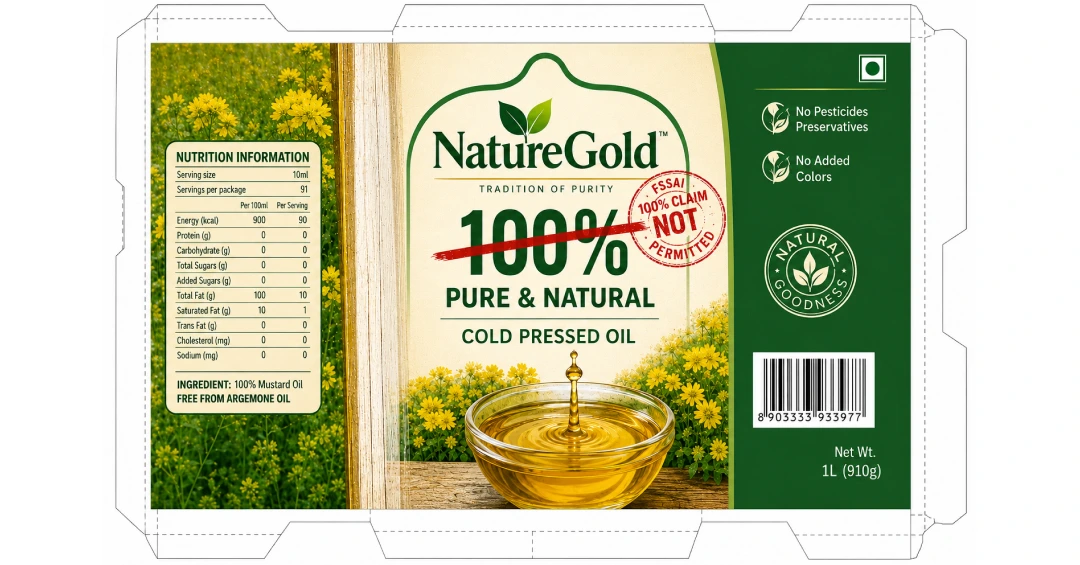


From July 1, food brands in India will need to remove claims such as "100%", "100% Pure", and "100% Natural" from packaging and promotional material. The move follows FSSAI's view that absolute claims like these can mislead consumers by creating a false impression of purity or superiority.
Though the FSSAI 100% claims ban looks like a small change, the operational impact can be significant. What starts as a wording update can quickly lead to hundreds of artwork reviews, multiple approval cycles, supplier coordination, and decisions about existing packaging inventory.
We covered the regulation itself in an earlier article FSSAI Warns Against Using “100%” in Food Labels—Here’s Why. This one is about what happens next, when someone asks the question that turns a wording change into a project: how many artworks do we actually need to update?
Let's take an example of a mid-sized food company with 500 SKUs, four language variants per SKU, and three pack sizes. That's not 500 artworks. That's 6,000 unique files. Now assume only 30% carry a "100%" claim. You're suddenly looking at 1,800 artworks that need review.
The number itself is only part of the problem.
Before a single artwork can be updated, teams first need to identify those 1,800 files. That sounds straightforward until you realise packaging assets rarely live in a single system. Over time, files become scattered across shared drives, regional repositories, designer folders, supplier systems, archived project folders, and countless email threads.
The moment a regulatory update arrives, questions start piling up.
What began as a wording change has now become a search exercise. Teams aren't updating artwork yet. They're trying to find it.
Only after those questions are answered can the actual review begin. Every affected file still needs to be checked to determine which SKUs carry the claim, which language versions contain it, which pack sizes use it, which versions are live, and which files have already gone to the printer.
Without clear visibility into packaging assets, compliance becomes a search-and-recovery operation before it becomes an update project. And as portfolios grow across products, languages, and pack formats, that search becomes increasingly difficult to manage.
Once the affected artworks have been identified, every update enters an approval cycle. Regulatory reviews it. Marketing checks it. Quality signs off. Procurement and production need updated files.
A designer can remove a claim in minutes. Getting that file reviewed, approved, released, and distributed takes days or weeks. Now run that across hundreds of SKUs, several categories and multiple sites. The bottleneck stops being artwork creation and becomes coordination, which is exactly what stretches a "quick fix" past the deadline. Hence, the challenge isn't the change itself but repeating that change consistently across hundreds of packaging assets.
Here's the cost that rarely makes it into compliance conversations - inventory. Brands don't print packaging a week at a time. Many hold significant stocks of pre-printed material across factories, warehouses, suppliers, and co-packers. The moment the rule lands, you have to answer some uncomfortable questions:
Without clear answers, costs accumulate quietly. Most organizations expect the effort of updating the artwork. What they often underestimate is the cost of managing existing inventory, coordinating the transition, and preventing outdated packaging from continuing through the supply chain.
Once approved artwork is released, distribution becomes its own risk point. Updated files have to reach packaging suppliers, printers, converters, contract manufacturers and regional sites. Everyone needs the correct version, every obsolete version has to be retired, and every location has to know when to switch. A single outdated file can put non-compliant packaging into production after the deadline.
This is where version control stops being an administrative process and becomes a packaging compliance control. Even with FSSAI's predictable July 1 enforcement cycle, teams still need to assess the impact, identify affected artworks, complete updates, secure approvals, coordinate suppliers, manage existing inventory, and roll out new packaging. A strong approval workflow is what ensures the right file reaches the press and the wrong one doesn't.
The FSSAI's guidance on "100%" claims is just one example of the changes packaging teams deal with every year. Whether it's a new labeling requirement, an updated warning statement, a revised nutrition panel, or a market-specific compliance update, the pattern is often the same.
The regulation itself is usually clear. The challenge is understanding its impact across the packaging portfolio and executing the change before deadlines, inventory constraints, and production schedules start working against you.
The brands that handle these changes efficiently aren't necessarily the ones with the largest teams. They're the ones that can quickly identify affected artworks, verify approved versions, understand where those files are being used, and determine exactly what needs to change.

FSSAI has advised food businesses to stop using absolute claims such as "100%", "100% Pure", and "100% Natural" on packaging and promotional material. The concern is that these claims can create an impression of purity or superiority that may not always be possible to prove. As a result, brands using these claims need to review and update the affected packaging and marketing assets.
The change falls under FSSAI's annual July 1 compliance cycle. For brands, that means all affected packaging needs to be identified, updated, approved, and rolled out before the enforcement date. While the requirement itself is straightforward, the work involved can be significant for companies managing large packaging portfolios.
Brands need to identify packaging and promotional materials that contain affected claims, update the artwork, complete the necessary review and approval processes, and ensure compliant versions are distributed across suppliers, printers, and production sites before enforcement deadlines.

.webp)